From the earliest records we have of ancient Indian philosophy, we can see that the nature of the cosmos and man’s relationship to the cosmos was of great concern. From […]
Dharma
Interview with Kamala Masters
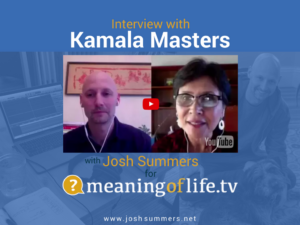
I am very pleased to announce a new opportunity that has developed for me. Robert Wright, author and founder of Bloggingheads.tv and MeaningofLife.tv, has invited to me to “try my […]
A Permanent Existence
In my last post, I began a look into some of the philosophical underpinnings of the Buddha’s worldview, and how this view shaped his orientation towards finding happiness and peace […]
Hacking Through the Thicket
“Everything in moderation, including moderation,” said Oscar Wilde. Advocates of moderation often find their spiritual footing within the Buddha’s doctrine of the Middle Path. As its name suggests, the Middle […]
Shock and Trance Revisited (2/2)
“What the world needs most is people who are less bound by prejudice. It needs more love, more generosity, more mercy, more openness. The root of human problems is not […]
Shock and Trance, Revisited (1/2)
What’s the Buddhist perspective on… Paris? San Bernardino? Sandy Hook? Fort Hood? Syria? Lebanon? The Congo? The climate? The list goes on. Often, whenever there has been an incident of violence […]
Accomplished Fugitives
Recently, while working on the Oliver Sacks piece, I found myself browsing through Maria Popova’s fantastic website: www.brainpickings.org. For a trove of material on the meaningful life, one need not look any further. […]
Ode To Oliver
It’s been about a week now. Last Sunday, Dr. Oliver Sacks died. For those who have not yet had the great pleasure of reading Oliver Sacks, I’ll make the briefest of introductions […]
Holistic Development
Over the last few months, I have tried to explore a gentle critique of one modern, popular definition of mindfulness. While formulating this critique (here, here, and here), I’ve been wrestling […]
The Problem with Non-Judging
Over the last two entries, here and here, I began to look at the potential ways in which a popular definition of mindfulness can lead to mis-application and/or confusion within the actual practice. […]
Unlocking the Present
Last post, I began a gentle critique of a definition of mindfulness that comes from Jon Kabat-Zinn: “Mindfulness means paying attention in a particular way: on purpose, in the present […]
Minute of Definition
As you undoubtedly are aware, mindfulness is gaining in popularity; it’s seemingly everywhere now. So much so that it has its own name: The Mindfulness Movement. And as with any […]
Losing an “I”
Last week, I attended a public conversation between Sam Harris, author and neuroscientist, and Greg Epstein, the Humanist Chaplain at Harvard University. Watch the highlights here and the full video here. Harris has […]
Wise Stillness (Samadhi) 4/4: Twinkle, Twinkle
In the final installment on Wise Stillness (and also the final installment on these short reflections on the Noble Eightfold Path), I want to try and draw some themes together, […]
Wise Stillness (Samadhi) 3/4: Don’t Focus on the Breath
In the first two segments of this short series on Wise Stillness, I tried to emphasize two complementary attitudes that support the experience of stillness. The first, as beautifully articulated by […]
Wise Stillness (Samadhi) 2/4: No Other Single Thing
Essentialism. I recently came across a fantastic book by Greg McKeown with lots of ‘dharmic’ themes. The book is: Essentialism: The Disciplined Pursuit of Less. One of McKeown’s basic ideas is […]
Wise Stillness 1/4 (Samadhi): The Pleasure of Less
Stillness. And so we come to the final spoke of the Eightfold Path: Samadhi. Often, Samadhi is translated as ‘concentration’, but as Ajahn Brahm suggests in the clip below, it might […]
Wise Mindfulness (Sati) 3/3: Proper Balance
Balance. It’s a word we hear a lot about. Work-Life Balance. Fiscal Balance. Spiritual Balance. Protein-Carb-Fat Balance. And like so many of the spiritual faculties we read or hear about, balance, in […]
Wise Mindfulness (Sati) 2/3: Not Mickey Mouse Mindfulness
For this Minute, I wanted to address some of the misconceptions that tend to crop up around the popularized understanding of mindfulness. And these misconceptions are what I’m referring to when I say: Mickey […]
Wise Mindfulness (Sati) 1/3: Not What, But How
In these next few Minutes, I’ll be reflecting on, of all things, Mindfulness (Sati). Imagine that. Sati is the seventh aspect of the eight-fold path. Many previous newsletters (now archived on […]
Wise Effort 3/3: The Marvel of Unknowing
Last week I tried something different. At the end of the summer, I often sit a retreat at the Insight Meditation Society. But this year, the center’s schedule and my own […]